About Me

My photo
Ipoh, Perak, Malaysia
At present I am retired and spending my time mostly on fishing and photography. I bought my first SLR way back in 1982. It was a Minolta XG1. My last film camera was the Maxxum 9000. When the fantastic Sony Alpha 100 was launched, I changed over to the digital system. My Alpha 580 was acquired followed closely by my Alpha 77.

My main interest in photography is lifestyles, sports, sceneries, nature, birds and macro shots. Lately, I have spend more time on bird and nature shooting. As a regular contributer to some fishing magazines, I shoot quite a lot of photographs of anglers too....hence my photography blog is named 'SHOOT THE HOOKER'.


Having grown up near the confluence of two, the Kangsar and the Perak Rivers, it is not surprising that one of my main interest is fishing. My younger days were spent swimming and fishing.... with a bamboo pole, line and small hooks.Now while fishing, my friends and I do take a lot of photographs of anglers in action. The anglers must be careful so as not to accidentally hook on to a photographer. So I think as a reminder, I would like to name my fishing blog as 'HOOK THE SHOOTER'.

Monday, September 28, 2015

KALUI FIGHTING AT TANJUNG TUALANG


(This article was published in the September 2002 issue of Rod and Line Fishing magazine.)

All unarmed martial arts can be roughly divided into two categories. One is the hard style while the other is the soft style. The former is characterized by its firm stances combined with sudden attacks of speed and power. The soft style is poetry in motion. The moves of the soft style are smooth and easy flowing. It makes use of the opponents’ strength to its own advantages.
Why am I talking about martial arts in a fishing magazine? Well, if the fighting styles of our fresh water game fishes can be classified, then I think this method of explanation is the most appropriate. The tomans, sebaraus, kelahs and their likes should fit the hard style fighters to the dot. Their powerful leaps, fast rushes and snagging tactics make sure of that. The main exponent of the soft style aquatic world is none other than our giant gouramis.
Being flat bodied, it really uses it greater surface area to great advantage. Fighting a big kalui is like having a bout with a Tai Chi master. It will l glide from left at right, resisting your hard pumps. When you least expected it, the kalui will move with lightning speed to cut you off against some underwater snags (that is if its fine teeth do not cut you off first). A contest with a big kalui is always a bruising affair, testing your stamina to the limits.

My cousin, Lai, holding up his 2.6kg kalui. This gouramy relished chicken liver.

This was the explanation I used to answer my US based cousin’s inquires. Being a karate exponent (my cousin) I guessed this was the best way to let him know the fighting qualities of our fresh game fishes. Through our e-mails, we had being arguing about the superior fighting qualities of our tomans compared to the muskellunges. Of course being a patriotic Malaysian, I am pro toman. You cannot blame me if I added some brick-breaking and jumping-over-the- roof techniques to the toman’s arsenals. As a result I was under tremendous pressure when he came back for his annual holidays, full of misguided expectations.
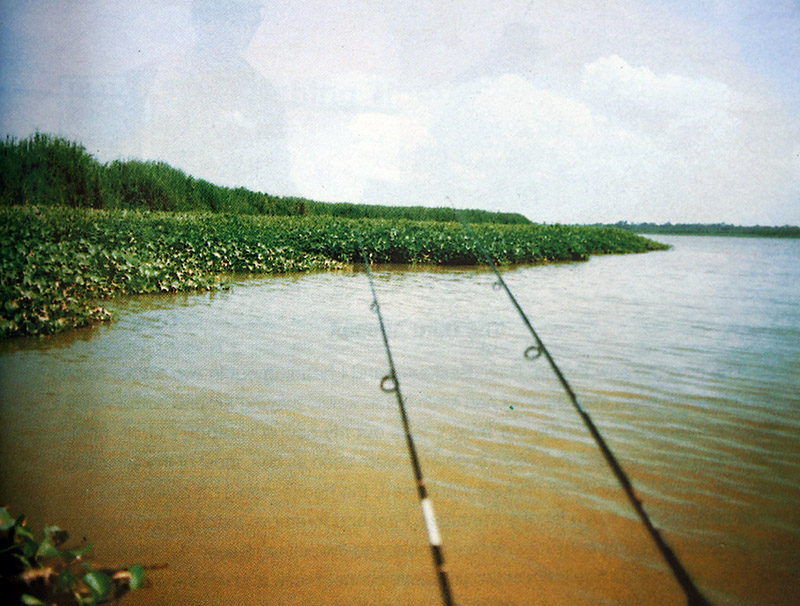
The type of weed patches where we fished for kaluis. If you could stay quiet and still, you might be lucky enough to see one or two kaluis propelling themselves almost totally our of the water to grab the water hyacinth flowers.

My heart sank further when we reached my usual fishing spot near Tanjung Tualang. Due to the dry spell, the water level was very low. Being one who was good at cooking up excuses, I conveniently blame the low water level to an act of God (good excuse if we were not to catch any tomans). Luckily for me my cousin, Lai Moon Lam, and his brother-in-law, Dr Chin Sou Fei, caught three tomans of about 2kg between them. My cousin finally ended our arguments by announcing that the tomans equals the northern pikes in fighting qualities, but loses out to the muskies. I kept quiet, as I have not met those fish in unarmed combats before ($$$$).
What surprised us most, during this trip, was a 2.6kg kalui which took my cousin’s liver bait (meant for tomans) and fought him aggressively. After having his trophy photograph taken, he gasped. Wah! Can fight lah. I guess that must have triggered my itch for kalui fishing for I just couldn’t wait for the next Sunday.

Baskaran with our two kaluis.

Baskaran and I were cruising out to the pond even before the sun was up, come Sunday. Easing our boat slowly along the mist-covered, we were wary of hitting underwater structures. The whole scene looked as though taken out of some Dracula films. Reaching our designated spot, we rammed our boat up onto some floating weeds. From then on it was a matter of keeping as quiet as possible. Everything was done in slow motion so as not to spook the ever-wary kaluis. If you could keep perfectly still and quiet, the kaluis could sometime be seen to propel themselves out of the water to grab at some insects or the purple flowers of the water hyacinth.

These were the buah aras that we used. they can be eaten. One of my colleagues from Sarawak told me that they eat it as ulam (salad).
 
Our baits consisted of the evergreen crickets and buah aras. Casting to the far side of the water hyacinth patch, we waited. After almost half an hour of patient waiting, my float suddenly bobbed and went under. Reeling in the slacks, I struck and was rewarded with a bulldozer. That brute went under the weeds and just kept taking line. All I could do was to push my rod tip under water and hoped for the best. Suddenly my line went slack and I reeled back my cut 15lb mono trace. Those tiny teeth sure did their job well.

One of my kaluis. those brakets you see on my sides were my boat rod holders (patent pending).

One hour of fruitless waiting later, we had no choice but to change to another spot. Here, the result was a lot better. We caught two kaluis each. Not big though, just about 1kg to 2kg in sizes. Anyway, it was still fun feeling the steady pull of the fighting kaluis. As the catch was not that good and our itch was not satisfied, we were already planning for the next trip on our way back.

Netting one of my kaluis.
 The next trip saw Keong, Ravi, Baskaran and I heading out in two boats. Keong and I headed to an area where I had seen some kaluis playing around some weeds a week earlier. After securing our boat, I took out my secret weapon- circle hooks. According to my experiences, when buah aras were used as baits, most of the fish caught were lip hooked. But when crickets were used, the hooks would be swallowed deep down. Lip hooking has a lot of advantages. First and foremost, catch and release can be practiced without causing any real problem to the kaluis. Secondly, thinner traces can be used, as the fine teeth of the gouramis cannot reach and cut the monofilament during hard fight. Thicker leaders can be used to overcome this problem, but will reduce the number of bites drastically.
Keong was the first to tangle with a fish. This fish did not fight like a soft stylist. Its fast powerful runs had us puzzled. The mystery was finally solved when a jelawat was finally netted. Yes, they also relished crickets too. When my float shot up and laid flat on the water, I knew a kalui had taken my bait. I just reeled in my line slowly and let the kalui tighten the line (circle hook, remember?). The fish shot to the left and then turned to the right. I felt as though I had a wau bulan at the end of my line.

Keong holding up the jelawat that gobbled his crickets.

Once in a while the reel screamed in protest as the fish took line in powerful surges. In the end I had to cut the trace to release the fish, as the circle was deeply embedded in its gullet. The same thing happened to all the other three kaluis that I caught subsequently. I was really puzzled and distressed. Circle hooks are supposed to pull out of the stomach and lodge at the corner of the fish mouth when it turn and run! Beats me!
Still deep in thought, I was brought back to the present, when my rod started to jerk. A big brute had taken my bait. Big fellow, lah! I gasped to Keong. When it glided the weed edge my heart sank. I could see the two bamboo poles sticking out of the water. True enough, my fish got entangled with the rawai and used it to break loose. The rawais are always a problem to us anglers, but what can we do? The pros have to fill their stomachs too. Conflict of interest, I guessed.
A gust of cold wind snapped us out of our gloom. Looking up, the whole sky was dark with rain cloud swarming everywhere. Keong screamed through his walkie-talkie (he is in the construction business) to Baskaran to flee. Gunning our boat, we skipped over the ponds to find Baskaran and Ravi waiting for us at the rendezvous point. By then it was too late. Strong wind and heavy rain were lashing us from everywhere. As the water level was rather shallow at certain stretches, we were hitting bottom quite often.

My rig for kalui fishing.

Suddenly I notice my outboard was not spurting water through its pump indicator. Cutting out the outboard we had no choice but to drop anchor. In my mind, I was thinking of the money I had to spend for the impeller replacement. Keong was busy bailing to prevent our boat from being filled with water. As visibility was down to a few meters, Baskaran nearly rammed into us. When told about our outboard problem, he suggested that I use a piece of thin wire to unclog the pump indicator. God, was I relieved when I noticed water spurting out again when I cranked my outboard. When we finally reached our landing site, we were like four half-drowned cats.

Wednesday, May 20, 2015

JIGGING FOR RIVER HARUAN


This article was published in the August 2002 issue of Rod And Line fishing magazine.

Ah Seng and I had planned to fish for kuangs in some swamps where pythons and king cobras reigned supreme. The first three planned trips were cancelled due to heavy rain, which made that place inaccessible. The fourth one … well the owner of the 4X4 let us stepped on the water melon skin (meaning given the slip).
The latest trip was planned with Ah Wai providing the small lorry to transport our motorbikes to the fringe of the swamp so that we could move around those areas not accessible to big vehicles. Baits were bought and provision stocked when disaster struck. Ah Seng (a mechanic) phoned up on the eve to inform us that his leg was hurt by a falling transmission shaft. He big-heartedly offered to take us to that place and wait in the lorry while we fish. How could we be so heartless to accept? Thus ended our fifth planned trip.
When the situation became desperate, anglers were adaptive. Ah Wai came up with the idea of jigging for haruans at the Lower Perak River area.
The two boats tied together moving as one.
At six in the morning saw our convoy of two car toppers on a car and a lorry heading towards the Kampung Gajah area. Breakfasts of roti canai were gulped down hurriedly before rushing off to our destination. Turning off from the trunk road, we came to the river bank at Kampung Pulau Besar near Teluk Intan, Perak. After loading our boats we suddenly realized our oars were left behind back home. Branches and umbrellas became very useful suddenly. They were improvised to row the boats out to the main river as this area was crisscrossed with nets and rawais. Cares were taken not to antagonize the local professionals, as the reason was obvious. The outboard on my boat started with only two pulls. Ah Wai’s outboard chose to go on strike at the wrong moment.
Richard and Ah Lek showing their catches.
Poor Ah Wai had to remove his shirt as he was sweating from the exertion of pulling on his reluctant outboard. The engine was suspected to have blown a gasket as it had overheated during the last trip (they forgot to check the outlet hole after hitting a sandbank). There was no choice but to tie the two boats together to move as one. With slightly swollen river from the overnight rain, progress was slow as we were using only one outboard.
Not to be outdone. Ah Wai show his haruan too.
Reaching the first patch of weeds growing out of the shallower of the Perak River, we rammed our boats into it. It could be because of the din that we created, as there was not a single bite.
We anglers were fast learners. Moving over to another patch of weeds, we could hear sounds of haruans gulping down some poor creatures. This time we didn’t spook the fish for we were using some bamboo poles found in the weeds to pole the boats around.
The weed is so thick that you cannot even see the boat.
Being the first to pull up a haruan, Ah Wai was having a smug on his face. Not to be outdone, Richard also got one, only a cheroot. Somehow the action died down and it was time to move on. Here at the next patch, Ah Lek got hit by a real big fella. The sound of its strike resonated over to our boat five meters away. Turning around we saw Ah Lek straining on his rod, bent dangerously near to breaking point. As always with this method of fishing, the big fellas almost always get way. This monster (estimated unanimously to be almost 2 kilos) wrapped itself around the weeds and pulled the hook out. Our poor Ah Lek was a figure of dejection. All this while Looi and I on my boat did not even raise a strike. They were beginning to call my boat gingko biloba boat (first started by James Wong). In Cantonese, ‘Pak kor chook’ or gingko biloba porridge means empty handed. Anglers are quite cruel on the whole, you know. They know all the methods of mental tortures.
Looi seen here jigging too.
By noon, the sun was unbearably hot thus forcing us to head for some shade for our food and siesta. We exchange boats when the weather was more forgiving (my boat had the good engine, remember?) This time Ah Wai pulled up a few good specimens followed by Richard and Ah Lek. Yes, yes, yes, Looi and I caught nothing again. Well, at least I had the consolation of people catching fish on my boat thus wiping off the name gingko biloba boat.
We nearly flattened a nest full of eggs nestled among the floating vegetation. After  taking some photographs of it we left it undisturbed.
Our method of fishing here was the same as in heavily weeded areas. The frog was flipped out and allowed to drop vertically into the weed.  Your hearing must be pretty sharp so as to listen to the tell-tale plop of your bait hitting the water. The rod tip was then flipped from ten to fifteen times before reeling in your frog and the process repeated elsewhere.
Do check the condition of your heart with your doctor first, as sometimes the strike could be heart stopping. I am sure you wouldn’t want to be the laughing stock in heaven, as the guy who was scared to death by a haruan. The method of tying the frog was the usual method, but I normally cut off both hind legs of the frog, failing which a lot of free lunches would be offered to the fish.
It was almost dark when we headed for home with yours truly and Looi still empty-handed. While polling through the weeds, we nearly flattened a nest full of eggs (could be some water fowls’ nest). After taking some photographs of it, we left it undisturbed.
Maybe it could be psychology, but the five river haruans that we had for dinner at Tanjung Tualang tasted better than their pond cousins. The flesh was firmer and tastier. Could be due to the fresh flowing water and the regular exercise.
The lower stretches of the Perak River still holds quite a variety of good size fishes. Of course, with a boat the area you cover will be a lot wider and the chances of being hit by a whopper greater. The important thing is to get to know the locals who know the area like the back of their hands. Of course respecting the local professionals, slowing down when passing them on the river, practicing catch and release will endear us to many of them. After all, to us sport anglers, the thrill is in the stalking, fighting and releasing of our quarries. Take only what is needed so that we don’t contribute to the depletion of the fish population any more than necessary.


Thursday, May 14, 2015

THE BRAND CONSCIOUS QUEENS


This article was published in the July 2002  issue of Rod and Line magazine.

I was introduced to lure casting around Pulau Sembilan in the early seventies. Those days, Kuala Sepetang (Port Weld) was our base where we made forays to the islands, the drop-offs and the old abandoned kelongs.
My sifu then was a friend from Taiping, who had graduated from Australia. After honing his skills and knowledge from down-under, he passed them on to us. Tony Toh introduced us to some lures with very funny names. From him I learned how to make my own “coffins”, “undertakers” and “executioners”.
Yes, these were the names of the lures that he brought back. I still possess a few self-made chrome heads, which we used together with rubber squids skirts to troll with deadly effect. Getting replacement skirts was a hassle as there were none in Ipoh back then. We had to show one to the dealers and beg them to stock some for us.

Leong with his presentable trevally on our previous trip. The forward stance is necessarily on  the rocking and swaying boat.
It was during this time that this “story telling Smart Alec” found out that the dolphin fish was not a mammal. You see, when my classmate, Cheah Meng, invited me to fish for dolphin fish with him and Tony, I gave him a mouthful of @#$%. “I only fish for fish and not mammal” was my ignorant reply.
When shown a photo of a dolphin fish or dorado I wanted to bury my head into the sand to hide my embarrassment.

The most handsome boatman (Leong's word) displaying two of his queen fish. James Khoo goes casting around Pulau Sembilan almost everyday. Can you believe that he wears out one spinning reel every month?


Those were the days where I learned to be a sport fisherman too. We targeted mainly trevallies, queen fish, tenggiris, barracudas, tripletails and at the beautiful dorados by trolling or casting lures. But everything must come to an end. Due to work, business and other commitments our group just drifted apart.
Since then I only do casting or trolling whenever I met up with some like-minded guys. With eight or nine fellows on a boat it was almost impossible to get everyone to agree to do lure casting. Of course, there were still some anglers who were keen to cast lures. The occasional trips were enough keep this fisho fighting fit.
Then one day Leong of Silibin Aquarium phoned to inquire whether I would like to join him to cast around Pulau Sembilan. The person who would be taking us there was James Khoo, the most handsome boatman around. Yes, I may be getting on in age, but I still do relish challenging the jumping queen fish and hard fighting trevallies around these islands.

A beaming Thang posing with his catches during one of the quieter moments. Can you see the Abu Koster? It is his main weapon.

When I saw James Khoo I know why Leong called him “the most handsome boatman around”. We sped off in Khoo’s 26ft boat powered by an eighty-five hp engine from somewhere near the Outward Bound School. Reaching Fairway Rock in just twelve minutes we began casting.
Our quarries did not seem to be around so we headed to the other islands. The water current was not that conducive, thus our catch was not very encouraging. The day’s final tallies were a couple of kilo plus queen fish and trevally. By the time we reached the landing point, the sun had long set. During this trip all the fish caught were with Abu Koster Flash.

The frenzy casting and fighting of fish near the Black Rock.

When Thang phoned me about the next trip, I was armed to my nose with lures. Being not that well endowed in the finance department, I had with me scores of imitation Kosters. At RM 2.50 each who wouldn’t buy? After all I had caught some trevallies with them so I was confident. When I tackled up my mates were all laughing and calling me cheapskate. Fuming I retorted “: I will show you”.
After bumping along for twenty minutes we finally reached Pulau Argus. While getting ready to cast, I commented that the todaks seemed to have vanished of late. As soon as we were in range, our lures flew out in unison. Immediately there were strikes and everybody was busy fighting their fish.
When we landed, the todaks thrashed all over the place. Every one of us landed at least three. When we kept pulling up those toothy creatures, James Wong commented, “you and your big mouth.”
“Make sure you eat all the todaks that we caught,” he grumbled again. (Be careful with these creatures as there had been cases of them causing fatal injuries.)

This trevally was one of the first fish to be landed by Thang.

When my lure was suddenly stopped, I realized immediately that this was no Senor Todak. My line kept on going out. That creature swung to the left then to the right. Pumping back some line, I was trying to catch a glimpse of that fish when it shot out again. The next time I brought the fish back, James Wong was shouting, “wah, at least 3 kilo trevally lah.” Being one who was never humble, I took the opportunity to get my revenge. “RM2.50 also can catch fish one lah,” I quipped.
Before I could finish, the fish went under the boat forcing me to dip the rod tip into the water. Desperately, I tried to steer it out from below when I felt a surge and the fish was gone. Reeling back my empty lure, I was a figure of dejection.
From then on, most of the islands that we visited produced the usual todaks and some queen fish. While Thang, the two James and Tan were getting all the action, my lure did not seem to attract any attention except for the occasional todaks. James Wong was teasing me about using cheapos, which even pomelo leaves could not help. Not wanting to admit defeat, I stubbornly blamed it on my poor reel. “Suei lah!” I joked. “Must clean with water soaked with thirty six types of flowers.”

Tan and James Wong each holding up their fish.

James Khoo was almost screaming when we were easing the boat towards a current line. “Talang, talang,” he gasped, pointing to the turbulent surface. The queen fish were attacking some baitfish.
There was pandemonium everywhere. Out shot four Abu Kosters and an imposter. Four rods were bent and groaning with four fish on. Reeling back my empty lure I flicked it out again. By the time they had landed a fish each, I was still casting and mumbling like a mad man.
In similar situations, some tennis players would throw their rackets on the floor.  I had heard of a world class badminton player throwing his racket into the crowd. It was a pity that I was not famous and my tackles were not sponsored or else I would have thrown them into the sea.

James Wong just pulled up a queen fish.

Moving over to the Black Rock, we were scouting around when our boatman pointed to some fish jumping in the distance. Making our way over, out shot five lures again. The same scene was replayed. Four rods curved into perfect Cs. Yes, mine was not among them.
Everywhere I looked, either it was Thang fighting talang or James Khoo pulling one into the boat. James Wong’s lure was hit and shot out of the water. When it dropped back, it was grabbed immediately.
Tan’s fish threw the lure when it jumped. When reeling back the empty lure, it was hit again by another talang. All these time my lure was not even nudged by the talangs. I saw a couple of fish following my lure, but they veered off when they neared the boat. Thang was kind enough to offer me his Kosters, which I declined. (Not wanting to admit defeat lah.)

Left: The RM2.50 imitation. Can catch the odd trevally (the short sighted ones) once in a while. Center: A well worn original. Notice that the split ring and the treble had been changed to something stronger. Right: A brand new original Abu Koster Flash. We suspected that the finish on the lure made the difference. The originals have a translucent shine on them.

By the time Thang had registered his twelve hit, I had to swallow my pride and sheepishly asked for one. By now the school had thin out. Most of the fish had left, led by those that threw the hooks, no doubt. With the original I had a hookup but lost it when it jumped.
Boy, I had never seen such acrobatic display before. The action was so thick and furious that I was in two minds whether to fish or to take photographs. There was an occasion when James Wong’s lure was knocked, missed, bumped, missed, bumped again, missed before finally hooking up a fish just one meter from the boat.
Casts after casts were made by me but there was no more queen fish anymore. By now it was already getting dark. I knew the others were dying to go back. Seeing the scowl on my face and my fishing knife nearby, no one dare to suggest it. Reluctantly I had to finally agree to head back. All the way back, I was suffering in silence as the jokes and puns thrown were at my expense. Luckily, the skin on my face was quite thick.

Please recycle: This would be a perfect casting spot, except for the eyesore. Look at the rubbish and debris. This was a common sight around Pulau Sembilan. We anglers can do our parts by at least refraining from adding more rubbish into the sea.

Result spoke louder than words. The cheapo can and do catch the occasional fish, but not as regular as expected. When compared to the original, there was no fight. The Abu Kosters outperformed the imitation hands down. Well, the first thing I did the next day was to stock up on my Abu Kosters. The original of course.